

Organic solar cell efficiency boosted by researchers at UNIST
Sign in to read and print this article.
The polymer/organic solar photovoltaic cells are preferred for their properties of lightness, flexibility, easy to manufacture and low-cost. The challenge for the researchers in organic solar cell is achieving higher efficiencies. There is continuous research going on to rise the efficiency levels of organic solar PV cells. Achieving the efficiency of 10% is good enough to make them commercially viable.
Korea-based UNIST research team have developed an amine based polar solvent treatment, which enhances the efficiency of inverted polymer solar cells (iPSC). Authors of this research have published their work in the leading science journal, the Advanced Materials.
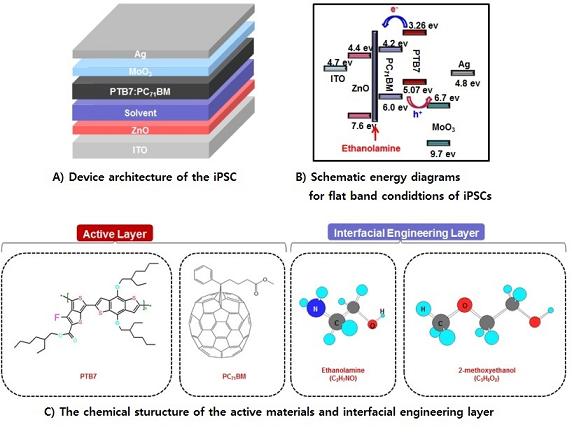
The release from the University has given the below explanation of this technology: Inverted organic solar cell (IOSCs) that are based on bulkheterojuction (BHJ) is highly attractive materials due to much better air-stability using metal oxides (ZnO, TiOx, and etc.) as buffer layers and high WF metals (Ag or Au) as top electrodes. In an inverted cell, the electric charges exit the device in the opposite direction as in a normal device. This happens because the positive and negative electrodes (which absorb the negative and positive charges, respectively) are reversed. Inverting the device architectur...
The release from the University has given the below explanation of this technology: Inverted organic solar cell (IOSCs) that are based on bulkheterojuction (BHJ) is highly attractive materials due to much better air-stability using metal oxides (ZnO, TiOx, and etc.) as buffer layers and high WF metals (Ag or Au) as top electrodes. In an inverted cell, the electric charges exit the device in the opposite direction as in a normal device. This happens because the positive and negative electrodes (which absorb the negative and positive charges, respectively) are reversed. Inverting the device architectur...
You've read this far — sign in to keep reading