

IHS: Solar PV microinverter shipments to grow 4x times by 2017
Sign in to read and print this article.
IHS has reported the global market for microinverters will expand by a factor of four from 2013 through 2017 as microinverters are adopted in greater numbers outside the United States while new markets also rush to take advantage of the devices’ improved efficiency and features compared to conventional inverters.
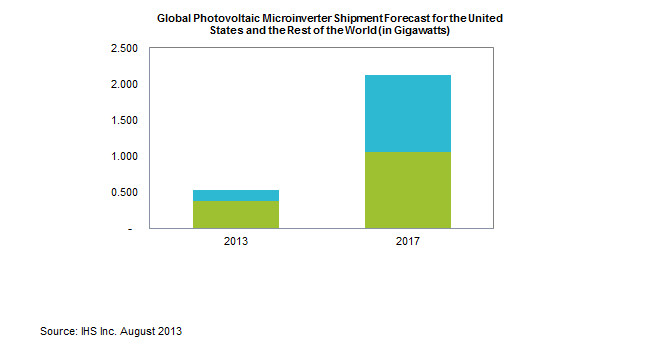
Below are the other market research points shared by IHS: Photovoltaic (PV) microinverter shipments worldwide are set to increase to 2.1 gigawatts (GW) in 2017, up from around 500 megawatts (MW) in 2013. Shipments during the period are forecast to rise fourfold, expanding at a 306-percent rate, as illustrated in the attached figure. Microinverters are devices that convert direct current (DC) electricity from a single solar module into alternating current (AC). Although they are more costly than conventional inverters, microinverters can increase the energy harvest of a system compared to conventional string or central inverter devices, which convert power from multiple solar panels. Until now, microinverter demand has largely been confined to the U.S. residential market. However, the emphasis is shifting to commercial solar systems and other regions. “Microinverters have reached very high adoption rates in the United States, particularly in the residential mar...
Below are the other market research points shared by IHS: Photovoltaic (PV) microinverter shipments worldwide are set to increase to 2.1 gigawatts (GW) in 2017, up from around 500 megawatts (MW) in 2013. Shipments during the period are forecast to rise fourfold, expanding at a 306-percent rate, as illustrated in the attached figure. Microinverters are devices that convert direct current (DC) electricity from a single solar module into alternating current (AC). Although they are more costly than conventional inverters, microinverters can increase the energy harvest of a system compared to conventional string or central inverter devices, which convert power from multiple solar panels. Until now, microinverter demand has largely been confined to the U.S. residential market. However, the emphasis is shifting to commercial solar systems and other regions. “Microinverters have reached very high adoption rates in the United States, particularly in the residential mar...
You've read this far — sign in to keep reading