

IHS: Combo MEMS sensors used in motor vehicles to grow by 77% in 2013
Sign in to read and print this article.
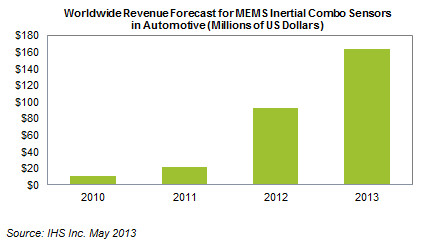
IHS iSuppli says global revenue in 2013 for combo inertial sensors used in motor vehicles will reach a projected $163 million, up a notable 77 percent from $92 million last year. The anticipated increase continues a hot streak for the market, which saw a phenomenal 338 percent surge last year from just $10 million in 2011.
Combo inertial sensors are multiple-sensor devices integrating accelerometers, gyroscopes into a single package, providing inertial inputs to the electronic stability control (ESC) system in cars to prevent or minimize skidding. “ESC systems are mandated in North America, Europe and in other areas where the edicts are maturing, such as Australia, Japan, Canada and South Korea,” said Richard Dixon, Ph.D., principal analyst for MEMS & Sensors at IHS. “But a huge growth opportunity exists in untapped territories like China, which would significantly impact the penetration of ESC worldwide given the vast size of the Chinese market. Such gains, in turn, would provide tremendous impetus and momentum for automotive combo sensors overall.” Further details of analysis shared by IHS: Why combos? Three architectures are currently possible for ESC systems in cars: on a printed circuit board as a separate ESC engine control unit (ECU); attached to the brake mod...
Combo inertial sensors are multiple-sensor devices integrating accelerometers, gyroscopes into a single package, providing inertial inputs to the electronic stability control (ESC) system in cars to prevent or minimize skidding. “ESC systems are mandated in North America, Europe and in other areas where the edicts are maturing, such as Australia, Japan, Canada and South Korea,” said Richard Dixon, Ph.D., principal analyst for MEMS & Sensors at IHS. “But a huge growth opportunity exists in untapped territories like China, which would significantly impact the penetration of ESC worldwide given the vast size of the Chinese market. Such gains, in turn, would provide tremendous impetus and momentum for automotive combo sensors overall.” Further details of analysis shared by IHS: Why combos? Three architectures are currently possible for ESC systems in cars: on a printed circuit board as a separate ESC engine control unit (ECU); attached to the brake mod...
You've read this far — sign in to keep reading