
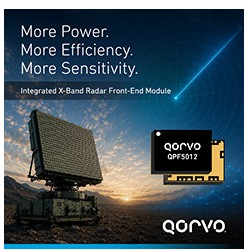
Qorvo has introduced the QPF5012, a fully integrated transmit/receive front-end module for X-band radar systems, targeting defense applications where size, weight, and power consumption collectively known as SWaP are critical constraints. The module is notable for solving a tradeoff that radar designers have historically had to accept: you could have high output power, or good efficiency, or strong receive sensitivity but rarely all three in a single compact package.
X-band radar operates in the 8–12 GHz frequency range and is widely used in defense systems for target detection, tracking, and fire control. Modern radar systems increasingly use Active Electronically Scanned Arrays (AESA) phased arrays where hundreds or thousands of individual transmit/receive modules work together, each steering the radar beam electronically rather than mechanically. In these systems, every single front-end module contributes to the overall system performance, so improvements at the module level multiply across the entire array.
The front-end module sits at the antenna interface it amplifies the outgoing transmitted signal and processes the weak incoming received signal. Its performance directly determines how far the radar can see, how accurately it can detect targets, and how much heat the system generates.

The QPF5012 operates across 8.5 to 10.5 GHz and integrates the full transmit/receive chain into a single 7 × 5mm package roughly the size of a small fingernail. Key performance figures:
· 10W saturated transmit power: strong output for extended detection range
· 42% power-added efficiency (PAE) : meaning 42% of the DC power consumed is converted into useful RF output, with the remainder becoming heat. For context, this is a high efficiency figure for a module at this power level, directly reducing the thermal load on the system
· 2.1 dB noise figure : a low noise figure on the receive side means the module can detect weaker return signals, improving sensitivity and effective radar range
Together, these specs address the three traditional pain points in radar front-end design simultaneously. High transmit power extends range. High efficiency reduces the prime power draw and heat generated critical in airborne or space-constrained platforms. Low noise figure improves the ability to detect distant or low-signature targets.

Beyond the raw specs, the integration itself is a significant design benefit. Combining transmit and receive functionality into one module reduces component count, simplifies PCB layout, and maintains consistent RF output power even as antenna load changes during beam steering across different scan angles. In large AESA arrays, this consistency across scan angles translates directly into more reliable and uniform radar performance.
Qorvo achieves this through vertically integrated RF design meaning they control the semiconductor process, packaging, and manufacturing under one roof which gives them tighter control over performance and reliability than multi-vendor approaches.
The QPF5012 is being demonstrated at IMS 2026 (IEEE International Microwave Symposium) in Boston, June 7–12, Booth 20036. Samples are currently available.