
STMicroelectronics announced the Stellar P3E, described as the first automotive microcontroller (MCU) featuring built-in AI acceleration for automotive edge intelligence. The Stellar P3E is designed for future software-defined vehicles and simplifies multi-function integration for X-in-1 Electronic Control Units (ECUs) that reduce system cost, weight, and complexity. It provides flexible, real-time performance for safe and responsive applications, including hybrid/EV systems and body zonal architectures.
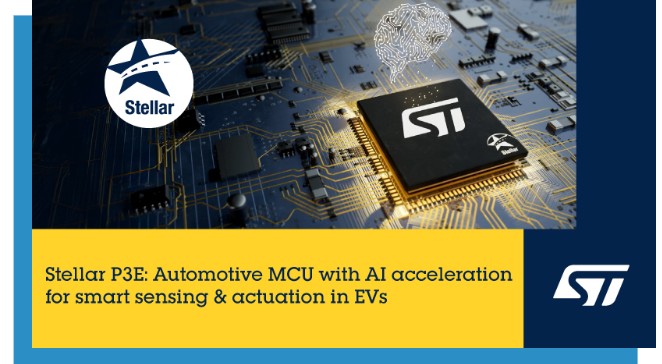
A key feature is the integrated ST Neural-ART Accelerator, a dedicated neural processing unit (NPU) with an advanced data-flow architecture for AI workloads. This makes it the first MCU with an embedded neural network accelerator in the automotive industry. Combined with rich sensing capabilities, it enables smart sensing applications such as virtual sensors.
The device delivers inference processing at microsecond speeds, achieving up to 30x greater efficiency compared to traditional MCU core processors. This supports always-on, low-power AI for real-time functions like predictive maintenance and smart sensing. These capabilities can improve charging speed and efficiency in electric vehicles and allow rapid deployment of new features in the factory or field. OEMs can introduce new functions and behaviors through different AI models, reducing the need for additional sensors, modules, wiring, and integration effort.

Luca Rodeschini, Group Vice President and General Purpose and Automotive Microcontrollers Division General Manager at STMicroelectronics, stated that the Stellar P3E combines high-performance real-time control and edge AI in a single device meeting high automotive safety levels. He highlighted its processing power, AI acceleration, large and extensible memory, rich analog content, smart sensing capabilities, and intelligent power management functions as supporting applications like virtual sensors to enable safer, more efficient, and responsive driving experiences.
Greg Basich, Associate Director at Counterpoint Research, noted that shifting neural processing to the vehicle edge enables sub-millisecond decision-making essential for next-generation in-vehicle intelligence. Integrating AI hardware acceleration at the MCU level allows OEMs to deliver advanced capabilities like predictive maintenance and virtual sensor applications with low latency sensing and actuation control, without the cost and thermal burden of a full-scale SoC.
The Stellar P3E incorporates ST’s proprietary xMemory, a non-volatile memory based on phase-change memory (PCM). It offers twice the density of traditional embedded flash memory and is qualified for automotive environments, providing scalability and flexibility for dynamic software storage expansion to accommodate new features and updates without hardware redesign.
The MCU is supported by the ST Edge AI Suite, which covers dataset creation to on-device deployment. NanoEdge AI Studio is now available for the entire Stellar MCU family. The Stellar P3E is integrated into Stellar Studio, ST’s development environment for automotive engineers.
Production of the Stellar P3E is planned to start in the fourth quarter of 2026.
Key technical highlights include:
500 MHz Arm Cortex-R52+ cores delivering a CoreMark score exceeding 8,000 points, the highest in its class.
Split-lock architecture to optimize the balance between functional safety and peak performance.
Open Arm architecture leveraging a global developer community.
Rich I/O and analog capabilities supporting diverse functions, including advanced motor control for enhanced vehicle dynamics.