
ADVERTISEMENT
Advertisement
MCU

Renesas introduces RA0E2 MCUs delivering power efficiency and temperature resilience

Listen to this story

AI NARRATED
0:00 / 0:00

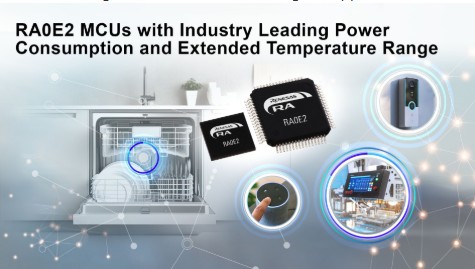
Renesas announced the launch of the RA0E2 microcontroller (MCU) Group. Based on the Arm Cortex-M23 processor, these new MCUs offer industry-leading power efficiency, an extended temperature range, and a comprehensive set of peripheral functions and safety features, making them ideal for a wide range of applications.
ADVERTISEMENT
Advertisement

The RA0E2 MCUs are the latest addition to the popular RA0 Series, which has quickly gained traction since its introduction in 2024. Known for their affordability and ultra-low power consumption, RA0E1 devices have been widely adopted in consumer electronics, appliances, power tools, industrial monitoring, and more. The new RA0E2 MCUs maintain full compatibility with RA0E1 devices, allowing customers to reuse existing software assets while benefiting from enhanced features.

Key Features and Benefits:
    Unmatched Power Efficiency: The RA0E2 MCUs deliver industry-leading power consumption, with only 2.8mA in active mode and 0.89mA in sleep mode. The integrated High-speed On-Chip Oscillator (HOCO) enables the fastest wake-up time in its class, allowing the MCUs to stay in Software Standby mode longer, reducing power consumption to a mere 0.25µA.
    Extended Temperature Range: The RA0E2 MCUs operate reliably in extreme environments, with a temperature range of -40°C to 125°C. The high-precision HOCO maintains ±1.0% accuracy across this range, eliminating the need for costly and time-consuming trimming processes.
    Comprehensive Peripheral Functions: The RA0E2 MCUs feature a wide operating voltage range (1.6V to 5.5V), integrated timers, serial communications, analog functions, safety features, and security functionality. This integration reduces the bill of materials (BOM) cost for customers.
    Flexible Software Support: Supported by Renesas’ Flexible Software Package, the RA0E2 MCUs enable faster application development. The FSP provides all necessary infrastructure software, including multiple RTOS, BSP, peripheral drivers, middleware, connectivity, networking, and security stacks. It also supports the integration of legacy code and choice of RTOS, offering full flexibility in application development.
 
For more information, visit renesas.com/RA0E2.

More from MCU