

Targeting robot motor control applications, the leading precision analog semiconductor manufacturer Texas Instruments has released semiconductor ICs to control these motors precisely and accurately. The new ICs AMC0106M05, AMC0106M25 and AMC0136 feature a galvanically isolated delta sigma ADC with a resolution of 12 to 14 effective number of bits for accurate and reliable phase current sensing and DC voltage sensing measurements. These devices are offered in small leadless package so that they can save the space on the boards which are inside robots.

These devices enable active smooth torque operation and fine motor controller while also decreasing the size and cost in low voltage robotic designs. The galvanic isolated modulator gives an advantage of precision control as well as protection in the case of achieving precise motor control inside robots.
“These modulators from TI enable designers to increase robotics accuracy and productivity in new use cases and smaller form factors, from the factory floor to the operating room,” said Karthik Vasanth, vice president and general manager of Data Converters and Clocks at TI. "For example, where humanoid robots could previously only complete simple tasks, our new functionally isolated modulators now allow them to carry out more dexterous and precise jobs.”

The device type is designed for current sensing with a peak-to-peak input voltage range of 50mV. It features a serial CMOS interface and is rated in the catalog. The minimum Common-Mode Transient Immunity (CMTI) is 150 kV/µs. The device has one input channel and utilizes a Delta-Sigma architecture. It boasts a Signal-to-Noise Ratio (SNR) of 82.5 dB and operates within a temperature range of -40°C to 125°C. The isolation rating is functional, with a working isolation voltage (VIOWM) of 200 Vrms and a transient isolation voltage (VIOTM) of 570 VPK. The minimum creepage and clearance distances are both 1 mm.
With a small package size and low input voltage range, the AMC0106M05 is designed for high accuracy, isolated current sensing in space-constrained applications. The galvanic isolation barrier supports high common-mode transients and allows for isolating sensitive control circuitry from switching noise from the power stage.
The output bitstream of the AMC0106M05 is synchronized to an external clock. Combined with a sinc3, OSR 256 filter, the device achieves 16 bits of resolution with an 82.5dB dynamic range and a 78kSPS data rate.
The AMC0106M05 is available in an 8-pin, 0.65mm pitch VSON package and is specified over the extended industrial temperature range of –40°C to +125°C.
The AMC0106M05 reduces PCB solution size by 50%
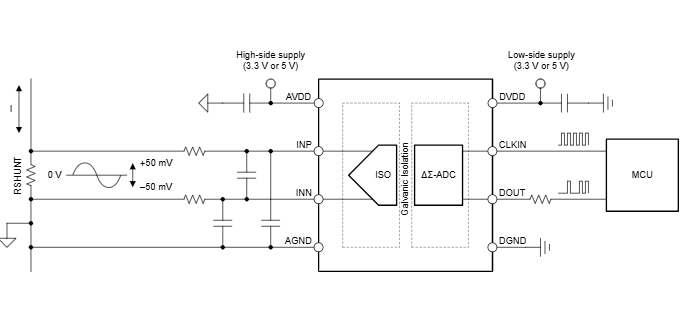
Image: Typical application diagram (Source: www.ti.com)
Why Galvanic isolated modulators are needed
Accurate, Low-Noise Measurements: Performing precise measurements of current and voltage in the presence of transient noise generated by three-phase inverters operating at low levels
Slower Torque Response: Ensuring robots have fast and precise torque response to perform intricate tasks smoothly and accurately.
Energy Efficiency: Optimizing energy efficiency in battery-powered robots while maintaining performance to avoid system failures and high operational costs.
Limited Space: Integrating current- and voltage-sensing circuits into compact humanoid robots without significantly increasing the size or weight of the system.
Isolation Requirements: Ensuring isolation between power and control circuits in high- and low-voltage domains to protect against short-circuit events or overvoltage conditions.
These challenges highlight the need for advanced sensing technology to improve the precision, efficiency, and safety of robotic systems