

Graphene nanoribbon double the Lithium Ion battery capacity
Sign in to read and print this article.
Researchers at Rice University have come up with a new way to boost the efficiency of the ubiquitous lithium ion (LI) battery by employing ribbons of graphene that start as carbon nanotubes.
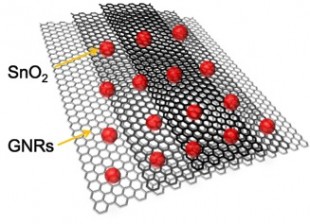
Graphene nanoribbons split from nanotubes in a process created at Rice University are now being used to improve the performance of lithium ion batteries. The nanoribbons in a solution with tin oxide have more than double the capacity for lithium than standard graphene anodes in current commercial batteries. Image courtesy of the Tour Group Proof-of-concept anodes — the part of the battery that stores lithium ions — built with graphene nanoribbons (GNRs) and tin oxide showed an initial capacity better than the theoretical capacity of tin oxide alone, according to Rice chemist James Tour. After 50 charge-discharge cycles, the test units retained a capacity that was still more than double that of the graphite currently used for LI battery anodes. The research appeared this week in the American Chemical Society journal ACS Nano. Better batteries are greatly desired by everyone who carries a cellphone or computer or drives an electric car. The Rice team sees the potential for GNRs to contribute to their development. Tour and his colleagues developed a method for unzipping nano...
Graphene nanoribbons split from nanotubes in a process created at Rice University are now being used to improve the performance of lithium ion batteries. The nanoribbons in a solution with tin oxide have more than double the capacity for lithium than standard graphene anodes in current commercial batteries. Image courtesy of the Tour Group Proof-of-concept anodes — the part of the battery that stores lithium ions — built with graphene nanoribbons (GNRs) and tin oxide showed an initial capacity better than the theoretical capacity of tin oxide alone, according to Rice chemist James Tour. After 50 charge-discharge cycles, the test units retained a capacity that was still more than double that of the graphite currently used for LI battery anodes. The research appeared this week in the American Chemical Society journal ACS Nano. Better batteries are greatly desired by everyone who carries a cellphone or computer or drives an electric car. The Rice team sees the potential for GNRs to contribute to their development. Tour and his colleagues developed a method for unzipping nano...
You've read this far — sign in to keep reading