

Panasonic announces twin-achievements in solid state light emitting
Sign in to read and print this article.
Panasonic Corporation has developed a white Organic Light Emitting Diode (OLED) with record luminous efficiency of 114 lm/W (light-emitting area of 1 cm²). Panasonic also achieved luminous efficiency of 110 lm/W with a device with a larger emitting area of 25 cm². Panasonic has used "light extraction technology" and the "all phosphorescent white OLED technology" (technology for the multilayering of the organic emitting layer) to achieve this.
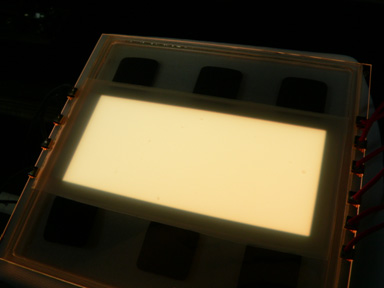
Panasonic explains: OLEDs are capable of emitting any color including white when a voltage is applied by combining organic materials that emit various colors such as red, green, and blue. The soft surface luminescence makes OLEDs suitable for lighting a wide area, and along with the benefits of being not overly bright when viewed directly and a thin and lightweight structure, they are receiving attention as the next generation light source. Lighting devices equipped with the high efficiency OLEDs are considered to achieve a luminous efficiency comparable to or higher than that of fluorescent lamps (approx. 60-80 lm/W) or LED lighting fixtures (approx. 80 lm/W) currently available in the market. Further, a wide variety of applications are expected for OLED devices, including use in general lighting. White OLED lighting will cre...
Panasonic explains: OLEDs are capable of emitting any color including white when a voltage is applied by combining organic materials that emit various colors such as red, green, and blue. The soft surface luminescence makes OLEDs suitable for lighting a wide area, and along with the benefits of being not overly bright when viewed directly and a thin and lightweight structure, they are receiving attention as the next generation light source. Lighting devices equipped with the high efficiency OLEDs are considered to achieve a luminous efficiency comparable to or higher than that of fluorescent lamps (approx. 60-80 lm/W) or LED lighting fixtures (approx. 80 lm/W) currently available in the market. Further, a wide variety of applications are expected for OLED devices, including use in general lighting. White OLED lighting will cre...
You've read this far — sign in to keep reading