
Excelfore CTO Shrikant Acharya and eSync Alliance Marketing Working Group Chair Mark Singer explain why standardised cloud-to-edge communication matters for software-defined vehicles.
India's automotive industry has less legacy inertia than most markets, and that gives it a chance to build scalability in from the start. That was the message from Shrikant Acharya, CTO of Excelfore, and Mark, Chair of the eSync Alliance Marketing Working Group, in an interview with me in Bengaluru, on 16 November 2026.
From OTA to a connected platform
Acharya said that when Excelfore started, over-the-air (OTA) updating was only a concept. He described it as "a means to an end". The real aim was a completely connected environment, which meant managing remote systems and defining protocols that work together.
In 2016, he said, five companies, including Mentor Graphics, Alpine, ZF and Molex, came to Excelfore with different projects. Five different ways of working were not practical, so Excelfore proposed a common standard that everyone could understand and manage themselves.
The first implementation was for Visteon SmartCore, which integrates an Android system and an instrument cluster on a single platform. Visteon wanted the display not to crash if Android crashed. No spec existed for such an update, so Excelfore wrote one. Visteon then suggested that Excelfore take the spec and manage it. In 2017 the five companies opened the spec and wrote it together, and in 2018 the alliance was formed, with Excelfore as a founding member.
Before this, Excelfore built infotainment head units with Harman. Acharya said the same software was rewritten for every new platform, so the company moved to a fully connected platform that was standardised as well. That led to the software-defined vehicle (SDV).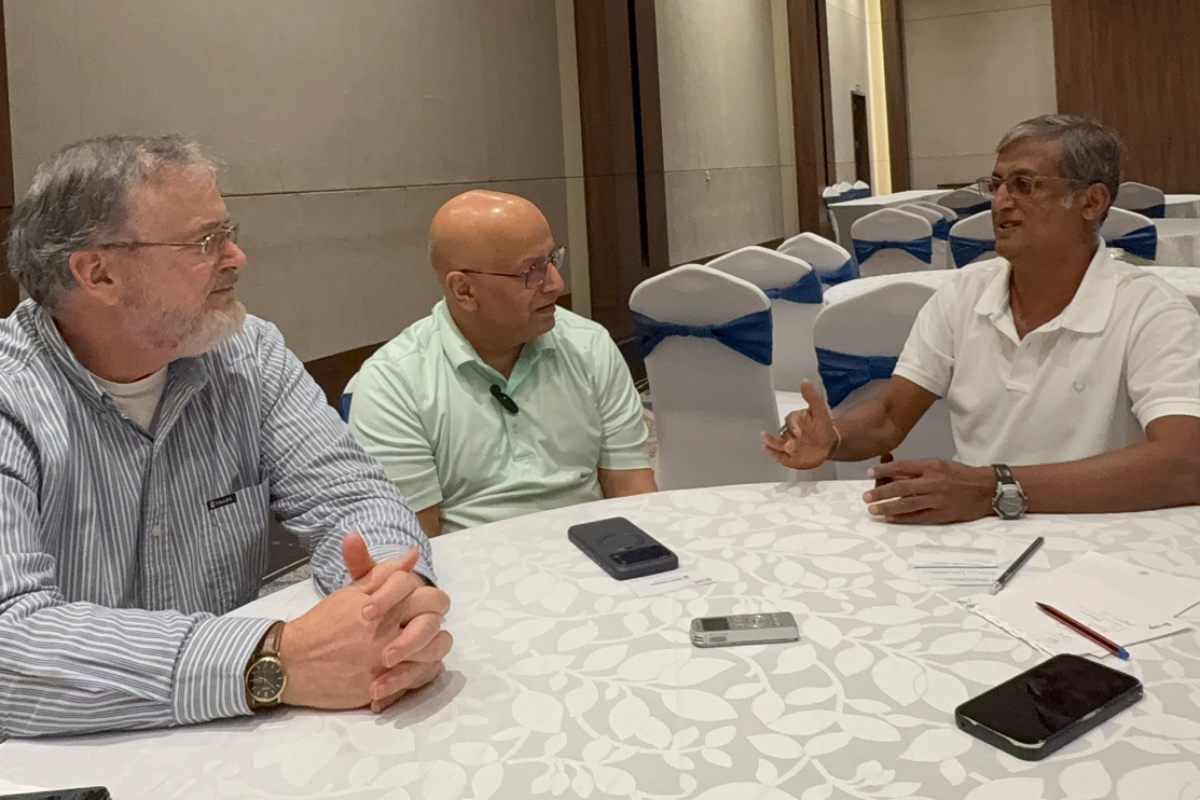
Pic: Mark Singer and Shrikant Acharya (L-R) speaking to Author
What SDV really means
Acharya said "software-defined vehicle" is a cliché without a clear definition, and everyone takes their own. In real terms, he said, it is a platform where loading new software gives it new characteristics. Calling any platform with software updates an SDV is "simply OTA".
SDV, in his view, starts with detecting a problem, diagnosing it and fixing it. Fixing is OTA, diagnosing means pulling data out of the vehicle, and analysis happens offline with AI tools. He added that cost is a real concern with AI: companies often find it high when they start, and cut back.
Mark said the key meaning of SDV is that a vehicle's feature set is determined as much or more by software than by hardware. A programmable ride management system, for example, can be tuned for a sports car, a luxury car, a family sedan or a light commercial vehicle. Once the data pipeline between vehicle and cloud runs in both directions, the automaker knows what software is running in every device in every vehicle in the field. It can then offer new features and services after the customer drives away from the dealer.
Why standards matter
Mark said the value of a communication link depends on how many things can communicate on both sides of it, and proprietary approaches limit that. He pointed to the CAN bus, which began as a Bosch proprietary technology. About 25 years ago Bosch opened it as a standard to customers and even competitors, and it became pervasive because the industry needed it. He said the same is now happening with how the vehicle talks to the cloud.
The scope extends to the braking controller, the backup camera and the ADAS computing platform. These are very different technologies, from small microcontrollers running an RTOS to high-performance platforms with a hypervisor. One way of managing each interface lets an automaker scale across vehicle numbers, product types and vehicle classes without changing how it talks to them.
Mark clarified what eSync does not do. It does not redefine the in-vehicle network or how a braking controller talks to an airbag controller. It is a higher-level messaging protocol between cloud services and edge devices. The specification is published and available to members of the Alliance, an open trade association that semiconductor companies, software and engineering firms, automakers, cloud providers and data communication service providers can join.
He also explained why automotive OTA is harder than updating a phone. A phone has one operating system, while a car may have 10 operating systems and 30 devices. Updating one component, such as the ride-levelling system, may require updating the airbag and steering controllers too, so that the vehicle never runs an untested combination. "That complexity is what creates the need for standards," he said.
The India opportunity
Mark said India is moving faster than Europe, North America or even Japan, with less legacy inertia and quicker decisions. He called its technology base and skill set "tremendous". The question, he said, is time and cost: why spend 10 years on something that doesn't scale well when a proven option exists? At the last count, more than 6 million vehicles with more than 85 million devices were connecting to the cloud using eSync. "This isn't a theoretical technology or an idea," he said.

The Alliance, he said, is in India because it is being "pulled" there. Automakers in India already use the technology and are asking for more, and their suppliers are asking how to participate. He described the Alliance as not static or "one and done", with members shaping what it becomes. The invitation, he said, is open both to those who want to follow and to those who want to lead.
A caution on "irrational exuberance"
Acharya sounded a note of caution. Many OEMs say they want to own the technology, he said, but what they own is the application, not the interface. They spend time and investor money, people claim expertise and move on, and the OEM is left with something patched together and no way forward.
"India can't afford to reinvent the wheel 10 or 15 times," he said. He called standardisation of communication protocols absolutely essential if SDV is to make an impact in India, because otherwise costs rise so high that vehicles can't be sold.
He described two kinds of scalability. One is the number of vehicles, which means the cloud end must be elastic. The other is inside the vehicle: under the standard, devices register themselves and the system works out the network from those registrations, so the same software can run a car with 10 ECUs or 35. Typical programmes take 24 months, he said, and standardisation can cut that to 9. Excelfore does it in 6 and can launch two OEMs a year.
He also separated reuse within your own environment from reuse across the industry. Redesigning supplier software for each automaker drives costs up, he said, and testability must be re-established every time. The consumer ends up paying. The Editor compared this to phone chargers, which weren't standardised until USB-C. Acharya agreed, adding that India's hurry shouldn't make it lose sight of what makes its vision sustainable.
SOVD and the silicon connection
Mark described how the Alliance has worked with ASAM, a German-based standards body, on SOVD (Service-Oriented Vehicle Diagnostics). Today a technician plugs into a port at the service shop and reads an error code. With SOVD, the technician can diagnose a vehicle remotely, over the air. He said combining eSync and SOVD in the vehicle has been a very successful programme, and that major Indian OEMs are using it because they want remote diagnostics as part of their cloud.
Semiconductor companies are also joining. Mark said Texas Instruments and Renesas were due to speak the following day about how they use eSync, from microcontrollers to chiplet SoC architectures. Arm and TI hold seats on the Alliance board of directors, and Renesas is a relatively new participant.
Mark described himself as a "refugee from the semiconductor industry", with 25 years at companies including Cirrus Logic, NeoMagic and Magnum Semiconductor. In those years he got to know Acharya, then a young multi-channel UART design engineer who was heavily involved in standards bodies.