

Carbon as a Material in Semiconductors and Electronics: Graphene, Nano-tube, Lab-grown Diamond
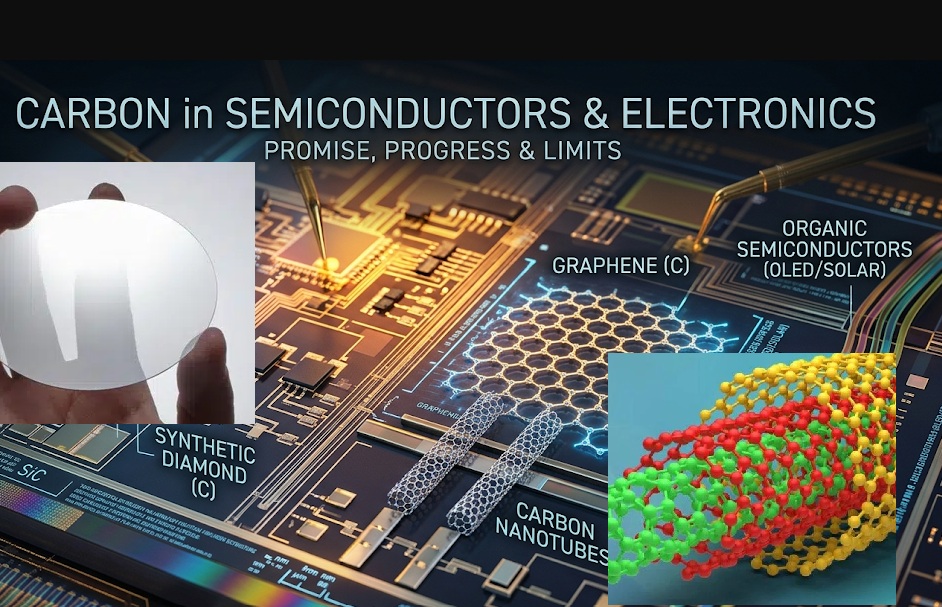
Carbon is already inside the semiconductor industry, mainly as silicon carbide (SiC) in power electronics and as organic molecules in OLED displays and solar cells. Newer carbon materials, namely synthetic diamond, graphene and carbon nanotubes, show remarkable properties in the lab, but each faces a specific unsolved problem that keeps it from replacing silicon in mainstream computing. The most likely future is carbon complementing silicon in particular niches, not displacing it everywhere.
Carbon makes up only about 0.02% of Earth’s crust by mass (roughly 200 ppm), which puts it around 15th among crustal elements, with the exact rank varying by source. By contrast, oxygen (about 46%) and silicon (about 28%) dominate the crust. Carbon is far more significant elsewhere: it is the fourth most abundant element in the universe by mass, after hydrogen, helium and oxygen, and about 18% of the human body.
Almost all of Earth’s accessible carbon is in compounds: carbonate rocks such as limestone, dissolved carbon in the oceans, organic matter, and fossil fuels. Atmospheric carbon dioxide is only about 0.04% of air (around 420 ppm). Turning CO₂ back into carbon is energy-intensive, because burning c...