

The Evolution of Processor Architectures: From CPUs to GPU, TPU and NPU powered AI Accelerators in 2026
Digital processors have transformed computing over the past five decades, evolving from basic loop like sequential/serial arithmetic and logic processing units to sophisticated vector processing capable parallel processing accelerators powering artificial intelligence. At their core, all processors perform simple binary operations such as additions, multiplications, and logical decisions using bits (0s and 1s). Yet architectural innovations have enabled complex tasks like matrix multiplications and linear algebra, essential for AI. A key operation is the multiply-accumulate (MAC): multiply two numbers and add the result to an accumulator. Billions of these MACs process data structured as matrices such as images where pixels form rows and columns of intensity values. Neural networks mimic brain-like pattern recognition through layered MAC operations, with weights adjusted during training.
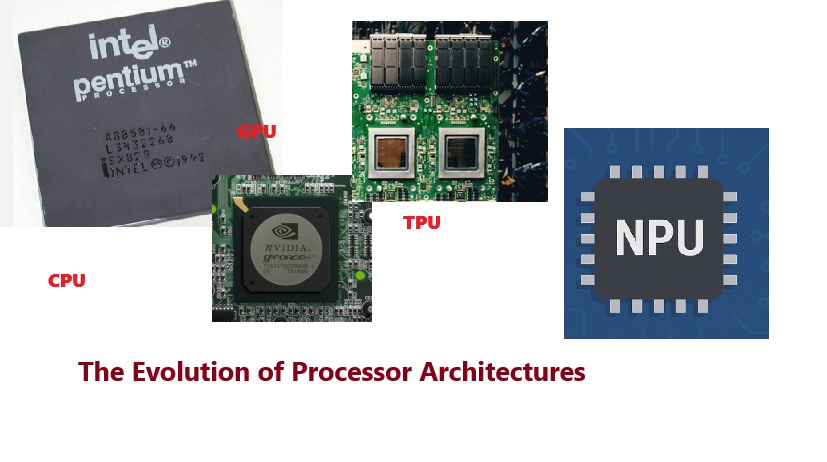
This evolution produced specialized processors: CPUs for general tasks, GPUs for parallel graphics and AI, TPUs for tensor operations where accuracy/resolution cut down to acceptable levels, and NPUs for efficient on-device AI.
As of January 2026, AI drives explosive growth in data ce...