
Introduction
ARM Cortex processor core is based on ARM RISC processor architecture version called ARMv7. The assembly language instruction set and other details of this ARM architecture is available for download at: ARM Arch . The pdf doc in the above link details full 32 bit instruction set of ARM Cortex.
The licensable 32 bit ARM processor architecture is widely popular for its low power consumption as well as lesser number of transistors/MOSFETS, it take per MIPS, resulting in smaller silicon semiconductor chip. The ARM processor architecture is owned by UK based ARM Holdings. More than 40 chip makers have licensed ARM Cortex M cores and offering microcontroller (MCU) chips with different features.
There are many other proprietary architectures more efficient than ARM but they are not open source and the software tools for them are unique, causing steep learning curve. ARM Cortex is popular for its wide usage and the easy availability of software and other development tools both for free of cost as well as paid.
ARM Cortex M series are designed for use in microcontroller chips. 15% of microcontroller chips in world are estimated to be ARM core based.
ARM Cortex M is available in 3 versions, they are M0, M3, and M4.
We provide you here with list MCUs available based on ARM Cortex M3 and M4 processor architecture.
ARM Cortex-M3 MCUs: The Cortex-M3 processor is the first ARM processor-based on the ARMv7-M architecture.
Key Features of ARM Cortex-M3: Thumb, Thumb-2 instruction set, 1-cycle 32-bit hardware multiply, 2-12 cycle 32-bit hardware divide, saturated match support, Pipeline: 3 stage with branch speculation, 12 cycle interrupt latency, Performance efficiency: 2.17 CoreMark/MHz - 1.25 DMIPS/MHz, Memory Protection: Non-maskable Input (NMI) + 1 to 240 physical interrupts, Interrupt priority levels: 8 to 256 priority levels
For more details, refer to: Cortex M3
Parts selection table from key vendors:
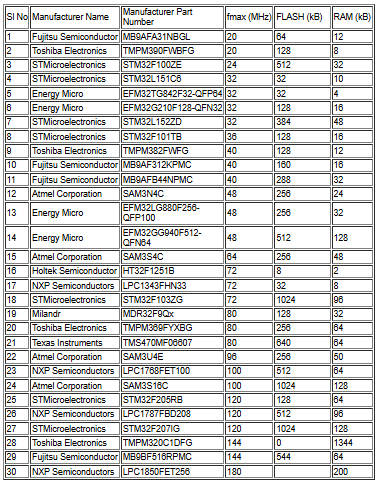
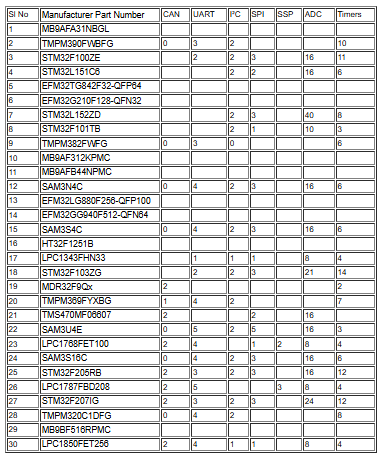
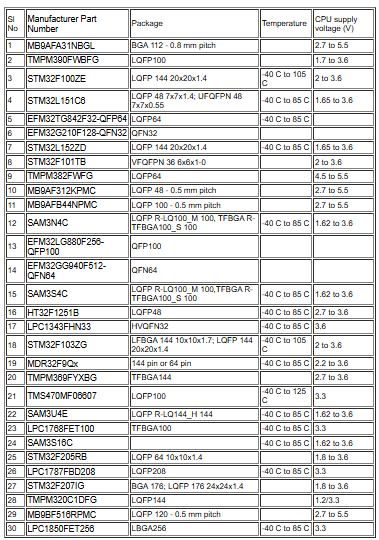
Toshiba offers a wide variety of Cortex-M3 RISC microcontrollers for a range of applications such as General purpose, Car-audio/display, Low Voltage/Power, Industrial, Motor control, Automotive, Timers, etc.,
For more details, refer to Toshiba Cortex

NXP's LPC1800 series operates at speeds up to 180 MHz, LPC1700 series operates at speeds up to 120 MHz and LPC1300 series at speeds up to 72 MHz. NXP's LPC1800 is said to be the world's fastest Cortex-M3 microcontroller.
More details are at NXP Cortex
STMicro's STM32 F1 is a series of Mainstream MCUs operates from 24 MHz to 72 MHz, STM32 L1 series is the ultra-low-power MCUs works at 32 MHz and STM32 F2 series is the high-performance MCUs that operates at 120 MHz that is built on 90NVM process technology with ART accelerator.
More details are at ST MCU
Fujitsu Semiconductor's FM3 family of 32 bit microcontrollers address a broad range of applications, from system controls to small mobile products and the company plans to expand the product line to reach more than 500 products from 210 in the year 2012.
More details are at Fujitsu MCU
ARM Cortex-M4 Microcontroller: ARM Cortex-M4 processor is a Cortex-M3 with the DSP instruction add-ons, and optional floating-point unit (FPU). If a core contains an FPU, it is known as Cortex-M4F, otherwise it is a Cortex-M4.
Key Features of ARM Cortex-M4: ARMv7-ME architecture, Instruction Sets: Thumb(entire), Thumb-2(entire), 1-cycle 32-bit hardware multiply, 2-12 cycle 32-bit hardware divide, saturated math support, DSP extension, Floating point extension, 3-stage pipeline with branch speculation, 1 to 240 physical interrupts, plus NMI, 12 cycle interrupt latency, Integrated sleep modes, 8 region memory protection unit (MPU) (silicon option), 1.25 DMIPS/MHz
For more details, refer ARM Cortex M4
Parts selection table from key vendors:
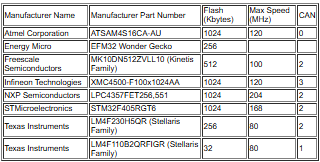
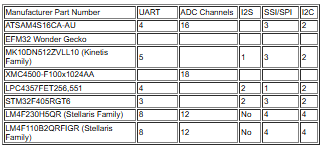
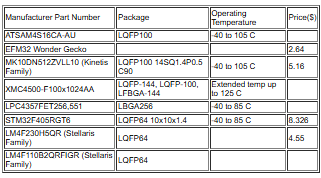
Energy Micro's EFM32 Wonder Gecko product family has 60 variants in the range is said to be the "low power" product. Claimed minimum active current consumption in Energy's M4F is 180µA/MHz. Deep sleep with the real-time clock (RTC) running is 400nA, down to 20nA in shut-off, with wake-up as short as 2µs.
At 204 MHz, NXP's LPC4300 is one of the fastest ARM Cortex-M4 microcontroller featuring unique asymmetrical dual-core architecture with two ARM processors - a Cortex-M4 core, optimized for real-time processing, and a Cortex-M0 core, optimized for real-time control. Both cores are capable of running at 204 MHz. For more details, refer cortex-m4
TI's Stellaris M4F microcontrollers offer floating point and a wide range of capabilities and peripherals. 12-bit ADC accuracy is achievable at the full 1 MSPS rating without any hardware averaging, eliminating any performance tradeoffs.
NXP is offering "emWin" Graphic Library free with ARM microcontrollers. Developed by SEGGER, emWin provides a robust, efficient GUI for any application operating with a graphical LCD, and features outstanding support for high-quality anti-aliased text and shapes. More details are at: NXP NEWS
Fujitsu Semiconductor has added a new FM4 family of 32-bit general purpose RISC microcontrollers based on the ARM Cortex-M4 processor core, featuring DSP and floating point (FPU) functions. In addition, Fujitsu is also introducing a new FM0+ family of devices based on the Cortex-M0+ core.
STM32 F4 from ST features the Cortex-M4 with FPU core and large memory capacity combined with high-speed 168MHz maximum CPU frequency for complex applications.
Note: The tables above are not 100% complete. There are chances of errors in specifications, please cross check with vendor's data sheets.