

IISc researchers turn infrared light visible
Sign in to read and print this article.
The human eye can only see light at certain frequencies (called the visible spectrum), the lowest of which constitutes red light. Infrared light, which we can’t see, has an even lower frequency than red light. Researchers at the Indian Institute of Science (IISc) have now fabricated a device to increase or “up-convert” the frequency of short infrared light to the visible range.
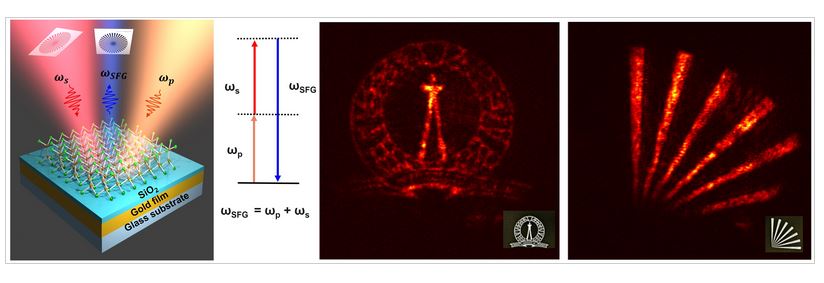
From Left to Right: Schematic of the nonlinear optical mirror used for up-conversion imaging. Energy diagram showing the sum frequency generation process used for up-conversion. Representative up-converted images of IISc logo and spokes where the object pattern at 1550 nm is upconverted to 622 nm wavelength (Images: Jyothsna KM) Up-conversion of light has diverse applications, especially in defence and optical communications. In a first, the IISc team used a 2D material to design what they call a non-linear optical mirror stack to achieve this up-conversion, combined with widefield imaging capability. The stack consists of multilayered gallium selenide fixed to the top of a gold reflective surface, with a silicon dioxide layer sandwiched in between. Traditional infrared imaging uses exotic low-energy bandgap semiconductors or micro-bolometer arrays, which usually pick up heat or absorption signatures from th...
From Left to Right: Schematic of the nonlinear optical mirror used for up-conversion imaging. Energy diagram showing the sum frequency generation process used for up-conversion. Representative up-converted images of IISc logo and spokes where the object pattern at 1550 nm is upconverted to 622 nm wavelength (Images: Jyothsna KM) Up-conversion of light has diverse applications, especially in defence and optical communications. In a first, the IISc team used a 2D material to design what they call a non-linear optical mirror stack to achieve this up-conversion, combined with widefield imaging capability. The stack consists of multilayered gallium selenide fixed to the top of a gold reflective surface, with a silicon dioxide layer sandwiched in between. Traditional infrared imaging uses exotic low-energy bandgap semiconductors or micro-bolometer arrays, which usually pick up heat or absorption signatures from th...
You've read this far — sign in to keep reading