

A start up turns semiconductor into a gel for SoC VLSI design engineers
Sign in to read and print this article.
If you have a ALU or registers or any such processor elements in a rigid fixed silicon, you are forced to use set of software and hardware tools designed for such rigid silicon. The advantage of FPGA is clearly the way out of rigid logic circuit and pattern, but still FPGA is not reprogrammable silicon in real time. What if processor core itself is virtual and its elements created in real time and wired through a code, that looks to be the idea driving the new semiconductor startup Soft Machines.
The processor core by Soft Machines is called VISC. Compare to CISC (x86) and RISC (ARM processor cores), VISC offers virtual cores/threads. The virtual processor cores scales not only on software but also the physical silicon, so it is mostly a kind of advance programmable silicon more advanced than FPGA. See the VISC block diagram below for better understanding:
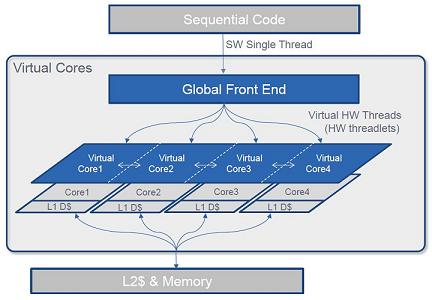
Close to ARM's big little concept, VISC allocates resources across threads based on the app needs but it looks to be more flexible than the ARM's processor cores computing handling. VISC cores are not limited by physical limitation of cores. VISC also uses virtual hardware threads instead of software threads for multitasking. This all means there is some amount of programmable hardware, but it is on...
Close to ARM's big little concept, VISC allocates resources across threads based on the app needs but it looks to be more flexible than the ARM's processor cores computing handling. VISC cores are not limited by physical limitation of cores. VISC also uses virtual hardware threads instead of software threads for multitasking. This all means there is some amount of programmable hardware, but it is on...
You've read this far — sign in to keep reading