

Embedded Systems Course- module 15: SRAM memory interface to microcontroller in embedded systems
Introduction:
Static Random Access Memory (SRAM) is a type of volatile semiconductor memory to store binary logic '1' and '0' bits. SRAM uses bistable latching circuitry made of Transistors/MOSFETS to store each bit. Compared to Dynamic RAM (DRAM), SRAM does't have a capacitor to store the data, hence SRAM works without refreshing. In SRAM the data is lost when the memory is not electrically powered.
SRAM is faster and more reliable than the more common DRAM . While DRAM supports access times (access time is the time required to read or write data to/from memory) of about 60 nanoseconds, SRAM can give access times as low as 10 nanoseconds. In addition, its cycle time is much shorter than that of DRAM because it does not need to pause between accesses. Unfortunately, it is also much more expensive to produce than DRAM. Due to its high cost, SRAM is often used only as a memory cache.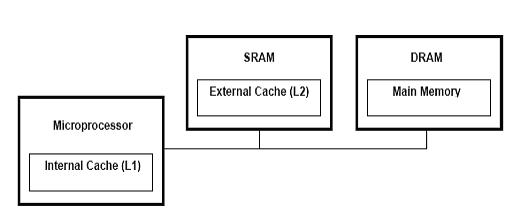
Fig1: Typical microprocessor memory configuration
SRAM is generally used for high-speed registers, caches and relatively small memory banks such as a frame buffer on a display adapter. In contrast, the main memory in a computer is typically dynamic RAM (DRAM, D-RAM).
An SRAM is designed to fill two needs: to provide a direct interface with the CPU at speeds not attainable...